


If you’ve been watching the Richmond market this summer and thinking “something feels different,” you’re right. Something is.
We’re not in the frantic pace of early spring. Homes are taking a little longer to sell in some areas. Buyers have more to choose from than they did a year ago (or even a few months ago). And sellers who hit the market with aggressive pricing are learning a hard lesson in real time.
None of this is terrible news. In fact, “normalizing” is the right word, and normal, after the last few years, feels like not a bad thing to be.
Here’s my personal take on where things are right now.
Rates: Same Song, Slight Variations

Source: Freddie Mac
The 30-year fixed averaged 6.49% as of July 9, down from 6.72% at this same point last year. Rates have been hovering in the mid-sixes since February. They bounce up a tick, down a tick, but not moving dramatically in either direction.
Most buyers have made their peace with this. The buyers sitting on the sidelines waiting for 5% have been sitting for a while now, and many of them are realizing that waiting has a cost too. Even when prices are growing more slowly, they’re still growing.
The short version: rates may not be your friend right now, but they’re not the enemy they were in 2023 either. They’re notably lower than last summer.
What “Normalizing” Actually Looks Like
Here’s the “quick and dirty” of what I’m seeing…
- Days on market are up a bit in some areas. In the city of Richmond, homes are averaging 21 days right now, up from a faster spring pace. Chesterfield is at 20 days, up from 15 days last year. Make no mistake, these are healthy numbers compared to other markets around the country. It’s just not the blink-and-it’s-gone pace of spring.
- In some (not all!) cases, buyers have more leverage than they did in 2024 or early 2025. Inspection contingencies are back (hallelujah!). List-to-sale ratios in the city have softened to about 99.1%, meaning buyers occasionally have room to negotiate.
- Overpriced homes are sitting. This is the clearest signal of normalization. Homes priced 5–8% above what comps support are taking 45–60 days and ultimately selling for less than if they’d been priced correctly from day one.
- Well-priced homes in good locations are still moving fast. The Fan and Church Hill are averaging 9–12 days. In Midlothian, well-priced homes are selling in 11–14 days, some still with multiple offers.
More options for buyers, more accountability for sellers. That’s what normal looks like. I’ve still had clients in multiple offer situations this month, so don’t get too excited. “Normal” isn’t the same as “slack.” It just means the market is making distinctions now. The best homes still go. The rest have to earn it, just a little bit more than they did a few months ago.
What’s Happening County by County
 Chesterfield
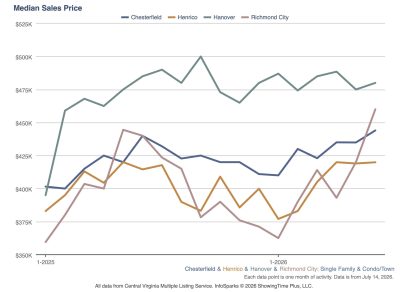
July median: $378,000, up 4.7% year over year. Average days on market: 20. Active listings up about 18% from last July. This is the most significant inventory increase in the metro (largely driven by new construction.)
The inventory gain is real but needs context: Chesterfield is still Virginia’s fastest-growing locality, with more than 36,000 new residents since 2020. Demand hasn’t dried up — supply has just come up to meet it more than before. Midlothian and Brandermill are still moving faster than the county average.
One thing worth knowing if you’re thinking of buying new construction in Chesterfield: a few builders near Route 288 are offering rate buydowns and closing cost credits to move summer inventory. Worth asking about before you sign anything. (Better yet, call me, and I’ll make sure you don’t miss a builder promo.)
Three-month median: about $419,000, with homes averaging 15–20 days on market and 460 homes sold in the past month. Zillow puts the average time to pending at 6 days, which is striking and consistent with what I see on the ground.
Western Henrico — Short Pump, Twin Hickory, Wyndham — is the tightest submarket in the metro. Supply there sits around 1.7 months (remember, a truly balanced market is about 6 months of supply.) Well-priced homes in those school districts still draw competition. If you find something you love in Henrico, the timeline for making a decision is basically immediately.
Hanover’s May median came in around $473,580, up 0.9% year over year. That’s steady, which is very Hanover. Buyers here are typically coming for the schools, the land, and the quieter pace, and that demand doesn’t fluctuate much with the broader market. (And yes, our really “official official data” still lags behind.)
Summer is actually a decent time to be selling in Hanover. The buyers who didn’t land what they wanted in spring are still active, and Hanover’s relative affordability within the metro keeps the pipeline steady.
Citywide median: $402,500, up 4.3% year over year, with 2.4 months of supply and an average of 21 days on market. Inventory is up about 17% year over year, giving buyers more options than at any point since 2022.
The variation within the city is wide. The Fan is averaging 9–12 days with a single-family median around $595,000. Church Hill is at $438,000, up 6.1%. That’s still moving well. Southside remains the most accessible entry point at around $268,000. The condo and townhome segment near Scott’s Addition and Manchester has more inventory than the single-family market, so there is finally a little opportunity for first-time buyers who’ve felt shut out.
If You’re Buying Right Now
The buyers doing well this summer are the ones who’ve shown up prepared. That hasn’t changed. What has changed is that you have a little more time and a few more options than you did in April.
- Get pre-approved before you start seriously looking. Not pre-qualified. Pre-approved. Even folks with the best of intentions can put this off and lose the house they love because they weren’t ready. I have great lenders I’m happy to put you in touch with, and there’s no hard sell.
- Use the breathing room wisely. More inventory means you can be more selective, but don’t mistake “more options” for “no competition.” The right home in the right neighborhood still goes fast, and in certain price ranges, they’ll give you whiplash. Again, normal is not “bad.”
- Know what a competitive offer looks like before you need one. That’s a conversation to have now, not in the parking lot after a showing.
- If the single-family search is not giving you what you’re seeking, maybe take a look at condos and townhomes. There’s more to work with there right now, for sure.
And if you’ve lost a home to another offer this year: you’re not alone, and it doesn’t mean you did anything wrong. Let’s look at what happened and adjust.
If You’re Selling Right Now
The normalizing market is not bad news for sellers. It’s an accountability market, and sellers who do the work are still doing well.
The ones who aren’t? The ones who priced aspirationally, didn’t prep their home, and are now sitting at week four wondering what happened? The fix is usually simple: a price correction and some attention to presentation. But in most cases, it’s a lesson that could have been avoided.
What’s working right now:
- Pricing based on what has closed in the last 60 days or so.
- Homes that are clean, updated in the important areas, and show well in photos
- Marketing that actually tells the story of the home rather than just posting it and hoping
You may be asking, “Well, then, should we wait until fall?”
Honestly, the fall market isn’t necessarily a better window. If you’re ready, summer listings with motivated buyers often beat the fall rush that competes with holidays and school schedules.
The Bottom Line
July 2026 feels different from April, and that’s appropriate. The spring rush has settled into a steadier summer pace, and with a more inventory and slightly longer timelines, there’s a bit more room for buyers to think and negotiate. Prices still up, demand still real, good homes still competitive.
This is what a healthy market looks like. It’s not as adrenaline-fueled as 2021, and that’s, you know- normal. Preparation still wins. Pricing still matters.