


I’ve been taking a course called “I Know Richmond” through The Valentine, and if you follow me on social media, you already know this. I haven’t stopped talking about it. Every session has been great, and I’ve learned so much about this city I love. But the one that seriously stopped me in my tracks was a visit to the Black History Museum and Cultural Center of Virginia with Faithe Norrell, followed by a walking tour of Jackson Ward led by historian Gary Flowers.
I thought I knew this neighborhood. I did not know this neighborhood half as well as I thought I did..
That’s the thing about Richmond. You can live here for decades and still find yourself standing on a sidewalk, listening to someone tell a story you’ve never heard, thinking: how did I not know this? Jackson Ward gave me several of those moments in one afternoon.
A Neighborhood With One of the Most Important Stories in America
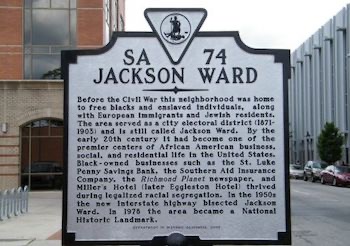
Jackson Ward is often called the “Harlem of the South,” and that comparison is earned. In the late 19th and early 20th centuries, it was one of the most prosperous African American communities in the country. A thriving center of Black-owned businesses, banks, theaters, and civic life, operating in full and remarkable force inside the suffocating constraints of Jim Crow Richmond.
Maggie L. Walker, born and raised here, became the first woman in American history to charter and serve as president of a bank. Her home on East Leigh Street is a National Historic Site. The neighborhood produced entrepreneurs, artists, and civic leaders who served a community the rest of the city systematically refused to.
You simply can’t really understand Richmond without understanding Jackson Ward.
The Story Behind the Bojangles Statue
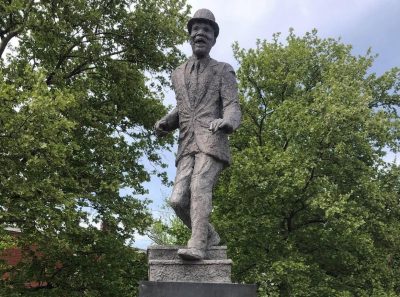 There is a 9½-foot aluminum statue of Bill “Bojangles” Robinson at the intersection of Leigh Street and Chamberlayne Parkway. Most people know Bojangles as one of the greatest tap dancers who ever lived, and as a Richmond native son. That part is true and worth celebrating on its own (and the reason I always thought that statue was there.)
But here’s what it’s is really about.
In 1933, Robinson saw what was happening at the intersection outside Armstrong High School, which was the segregated Black high school in Jackson Ward. Black children crossing Leigh Street to get to school had been struck by passing cars on more than one occasion. The city of Richmond knew. The city did nothing. So Robinson went to city council himself and paid out of his own pocket to have a stoplight installed at Adams and Leigh streets, so the children would be safe getting to school.
The statue, dedicated in 1973, was the first erected in Richmond to honor a Black person. It stands at that same intersection. And now, every time I drive through Jackson Ward, I see it differently.
That is what a good tour, and someone who knows their stuff, does. Gary Flowers did not just give us dates and names. He gave us the why behind everything. The personal stories, the neighborhood tales. And in Jackson Ward, those things absolutely tell a more layered story than the “official” one.
The Black History Museum
Before the walking tour, we spent a couple of hours at the Black History Museum and Cultural Center of Virginia, and I will be honest: it was a really powerful day. Faithe Norrell (a retired 42 year teacher and librarian whose grandparents were born enslaved), led us on the tour, and gave us context far beyond the placards on the exhibits.. The collections are significant, the exhibitions are thoughtful, and the building itself, the Leigh Street Armory, is a piece of history in its own right. (In fact, a lot of the brickwork on the Armory was done by Armstead Walker, Maggie’s husband. He specialized in the rounded forms like turrets, etc, done in brick.)
If you have lived in Richmond for years and have not been, make the trip. I promise, you will leave knowing more about this city than when you walked in. You might cry, which I did, and you’ll definitely leave with a different view of much of Richmond.
Where to Eat in Jackson Ward
The neighborhood’s restaurant scene reflects the same mix of history and momentum you feel everywhere you look here.
Start at Mama J’s Kitchen if you want to understand what soul food actually means in Richmond. Fried chicken, candied yams, cornbread. The kind of cooking that has its own gravitational pull, made by people who have been doing this for a long time and mean every bite of it. There may be lines, and if so, they are worth it.
 Then there’s Lillie Pearl, which is a whole different kind of special. Chef Michael Lindsey and his wife Kimberly Love-Lindsey built this restaurant as a celebration of his grandmothers’ legacies, taking West African heirloom ingredients and his North Carolina roots of Southern African American cuisine through a journey of global influences. The result is New American cooking that feels deeply personal without being precious about it. Brunch is where Lindsey is having the most fun, with dishes like a short rib breakfast burrito smothered in green chile queso and a peach cobbler French toast. Make a reservation and go check it out.
For something quieter and completely distinct, wander into Buna Kurs. Ethiopia is the birthplace of coffee, and those origins come to life inside this Jackson Ward cafe, where they brew their signature single-origin medium roast of Yirgacheffe beans every day. It is bright and fruity and not like anything else in RVA. The food is worth exploring too. This is the kind of place that makes a neighborhood feel genuinely interesting, and brings the feeling of a tapestry of culture.
The Architecture
Speaking of interesting: the streetscape in Jackson Ward is extraordinary and worth slowing down for. Ornate Italianate rowhouses with cast-iron details on the facades, Victorian-era buildings with bones that simply do not exist in new construction. This is a walkable, urban neighborhood where the built environment tells you something true about the people who built it and the community that sustained it.
What the Real Estate Market Is Doing
For buyers researching Richmond, Jackson Ward offers something rare: historically significant architecture in a central, walkable location with real cultural depth. Well-restored properties here move with urgency. Buyers who understand what they are looking at tend not to hesitate.
What you are buying is not just square footage. It is a neighborhood with a story worth knowing, and a daily life that has actual texture. That combination is harder to find than most people realize, and buyers who find it here tend to stay.
If you are relocating to Richmond and want to talk through what is available and what the neighborhood actually feels like on a Tuesday morning, I am happy to be your very opinionated local guide.
But first: take the walking tour, or at a minimum, do a little research. Everything else makes more sense after that.
Have you spent time in Jackson Ward? And if you are researching Richmond neighborhoods from out of town, what questions can I answer? This is exactly what I am here for, so bring on the questions!