
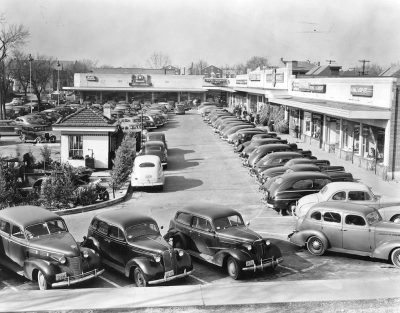
Photo: The Valentine Museum
Carytown: The “Mile of Style”, Then and Now
There’s a game that people who’ve spent time in Carytown used to play. The premise was simple: you could get absolutely anything in Carytown except for cars and guns. Someone would name three random items and the other person had to say where on the strip you’d find them. Darts for a dartboard, a pork pie hat, a king cake. Stumping someone was genuinely difficult.
That was the old Carytown. One concentrated, gloriously weird mile of mostly local, mostly independent businesses that collectively made the case that a shopping street could also be a community.
2026 Carytown is still working out who it is. And that conversation is what makes it interesting right now.
A Little History, Because Carytown Has More of It Than Most People Know
In 1927, what was then called the Westham Plank Road was renamed Cary Street, after Colonel Archibald Cary, a key figure in Virginia’s Revolutionary War movement. A year later, on Christmas Eve, the Byrd Theatre opened its doors for the first time. Then, in the late 1930s, the Cary Street Park and Shop Center opened as Richmond’s first strip shopping center, popular precisely because of its “park and shop” nature. (And yes, this is exactly where Gourmet Delights used to be, back in the day.)
For a few decades, Carytown thrived. Then when Willow Lawn Shopping Center was built in the 1950s, business along Cary Street began to slow. Richmonders found more parking and larger department stores out west, and Cary Street went through a slump that lasted into the 1970s.
What happened next says a lot about this neighborhood’s character. Residents and shop owners pooled funds to hire an off-duty police officer to patrol the area, which immediately cut down petty crime. Store owners then petitioned the city for two parking decks. The efforts worked. In 1974, there was a vote to rebrand the neighborhood, and “Carytown” received the most votes. The new name fostered a sense of community among residents and shopkeepers that still resonates today.
That scrappiness, that impulse to fix things from the inside, is still present on Cary Street if you know where to look.
The Byrd Theatre: Richmond‘s Best Reason to Go to the Movies
The Byrd Theatre opened on Christmas Eve 1928 and has operated almost continuously ever since, making it one of the nation’s finest surviving cinema treasures. Calling it a movie theater undersells it significantly. It is a French Empire-style movie palace with imported Italian and Turkish marble, hand-sewn velvet drapes, oil on canvas murals of Greek mythology, and an 18-foot, two-and-a-half ton chandelier hung with over 5,000 Czechoslovakian crystals illuminated by 500 colored lights. 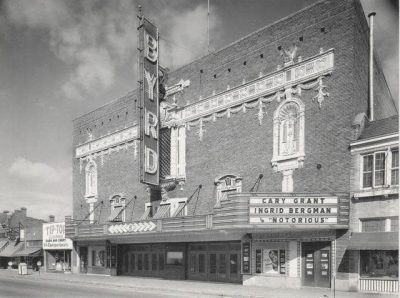
And then there is the Mighty Wurlitzer. One of only about forty surviving instruments remaining in their original installation out of more than two thousand made between 1914 and 1942, it was designed as a one-person orchestra to accompany silent films. It still gets played every Saturday night before the feature. The Byrd Theatre Foundation, which has stewardship of the building, is currently in the middle of an ongoing seat restoration project and organ conservation work. This place is being cared for. It shows.
Second-run movies. Eight dollars. Go on a Saturday and stay for the organ. That’s a good night in Richmond.
Can Can Brasserie: Paris, Dropped Into Carytown
Can Can is a French brasserie and bakery built to look and feel as though it has been lifted from the Left Bank of Paris and set down in the middle of Carytown’s retail strip, with dedicated bakery and pastry kitchens, a zinc bar imported from France, and a program of coffee, wine, and cocktails designed for everyday celebration.
In practice this means: go for a coffee and a pastry in the morning and you feel like you are somewhere significantly more glamorous than you actually are, which is the whole point. Brunch on the weekends is an event. The people watching from a sidewalk table is genuinely excellent.
Bev’s Homemade Ice Cream: A Carytown Institution
Bev’s has been scooping New England-style ice cream in Carytown since 1998, right across from the Byrd Theatre. When the founder retired in 2021, one of her longtime employees took over, vowing to keep the recipes, the culture, and the homemade character intact. She did. The ice cream is still made in-house, the flavors are still creative without being gimmicky, and the line on a warm evening still snakes out the door. Some Richmond institutions survive because they’re famous. Bev’s survives because it’s good.
Plan 9 Records: Because Every Great Neighborhood Needs a Record Store
Plan 9 has been on Cary Street long enough to feel like furniture. The kind of furniture you’d be devastated to lose. Independent record stores are one of those things people say they want to support until there’s a cheaper option available on their phone, and Plan 9 has survived that moment repeatedly by being genuinely, stubbornly good at what it does: curated vinyl, knowledgeable staff, local music given shelf space alongside the classics.
If you haven’t been in a while, go. Spend more than you planned to. Consider it a civic contribution.
The Conversation Carytown Is Having With Itself
This is where it gets a little complicated, and I think it’s worth saying honestly because it’s the real story of Carytown right now.
There was a time when you could come to Carytown and it was dead after six o’clock. Now, with the arrival of some national chains, smaller places are staying open until eight or nine at night. The trade-off is real. Chains bring foot traffic and extended hours. They also bring a homogenization that longtime residents feel and don’t love. The concern among local merchants is that if chains exceed 25 to 30 percent of the total business mix, the character of the corridor tips in a direction that’s hard to come back from.
In October 2024, a new Art Deco-style illuminated welcome sign was installed at Carytown’s entrance. Which is, depending on your perspective, either a sign of investment and civic pride or a sign that a neighborhood is being packaged for visitors rather than maintained for the people who live there. It’s really both.
What I’d say is this: the bones of Carytown are extraordinary and they are not going anywhere. The Byrd, Bev’s, Plan 9, Can Can, the Watermelon Festival every August, the walkability, the proximity to Byrd Park and the VMFA. The character is still there. The question is whether the businesses filling the empty storefronts over the next few years will reflect the neighborhood’s identity or gradually dilute it.
That’s a question worth paying attention to.
What the Real Estate Market Is Doing
Living near Carytown means buying into one of Richmond‘s most walkable and most perpetually in-demand corridors. The housing stock is primarily pre-1960s construction: duplexes, small apartment buildings, townhouses, and single detached homes with the kind of architectural detail and neighborhood texture that simply does not exist in new construction.
Properties here move. Condition and location on the grid both matter, but the desirability is consistent and has been for decades. If you are relocating to Richmond and want to be within walking distance of a great movie theater, a French brasserie, a record store, and an ice cream shop that has been in the same spot for nearly thirty years, this is your neighborhood.
It was the first shopping district in Richmond. It is still one of the best, and where I always send out of towners. That is not a coincidence.
Have you been to Carytown lately? What do you think of how it’s changing? And if you are thinking about a move to Richmond and want to talk through neighborhoods, I am genuinely your person for that conversation.