


Most of us who’ve lived somewhere for a long time develop a quiet, unexamined assumption that we know the place. We know the traffic patterns. We know which restaurants are actually good and which ones are just Instagram-famous. We know our neighborhoods (or at least, we know our version of them.)
What we often don’t know — and I say this as someone who has lived and worked in Richmond for most of my life, is the history. The actual, layered, complicated, sometimes devastating history of the city right underneath our feet.
I got lucky. The Valentine’s I Know Richmond course filled up before I registered, but I was first on the waitlist and a spot opened up the day before it began. Six Sunday afternoons, four hours each, exploring Richmond’s past and present in depth, with expert guides and behind-the-scenes access you simply can’t get on your own. I’m two weeks in, and I’ve already learned so much (and learned how much I still don’t know.)
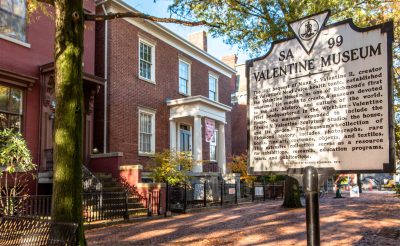
Week one was at the Valentine itself, and if you think you know what’s in that building, I’d gently suggest you might be underestimating it. We went a bit deeper than the main exhibits — into the backstories behind the collections, the photographs, the objects that look unremarkable until someone tells you what they actually meant to the people and communities who made them, owned them, or were shaped by them. Context changes everything. A label gives you a fact. A good guide gives you a world.
Week two moved us to the Black History Museum & Cultural Center of Virginia, in Jackson Ward — and this is where I want to stay for a while, because I have a confession.
I had never been.
I know. I know. It’s been on “my list.” I’ve recommended it to people who ask about Richmond. I’ve nodded along when friends mentioned it. But life “lifes,” and I had never actually gone inside.
Faithe Norrell led our tour, and she didn’t just walk us through the exhibits — she wove in her own personal stories, her own connections to this history, in a way that made the whole thing feel alive rather than dry and archived. That’s the difference between a tour and an experience. Richmond’s Black history is not a collection of objects in glass cases. It is a living, continuous story, and it is a story that Richmond has spent a very long time trying to tell around, rather than through.
I left genuinely moved. Changed. And more than a little embarrassed that it took me this long.
Here’s the thing I keep coming back to: Richmond was the capital of the Confederacy. That’s not a footnote. That’s a
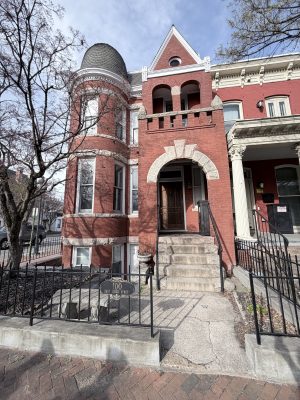
House on “Quality Row” (East 100-block of Leigh Street). Brickwork done by Armstead Walker, husband of Maggie L Walker.
defining fact about this city, and it has shaped (and distorted and suppressed) an enormous amount of what came after it. The Lost Cause mythology that took root here wasn’t just about the statues on Monument Avenue. It was about whose stories got told, whose history got funded and preserved and taught, and whose got left out of the books entirely.
The Black History Museum exists, in part, because of that gap. Because someone (many someones, starting with founder Carroll Anderson Sr.) decided that the full story of Black life in Virginia deserved to be collected, preserved, and told with the same care and permanence as everything else. The building itself carries history: the Leigh Street Armory, built by Black craftsmen (most notably, perhaps, Maggie Walker’s husband Armstead) in 1894 for Virginia’s Black soldiers, then converted almost immediately into a school for Black children when the city decided Black soldiers didn’t need an armory after all. That’s Richmond, sort of sum in one building. Pride and erasure, four years apart.
Faithe walked us through all of it. Not as a litany of grievances, but as the actual, complicated, deeply human story that it is. That’s harder to do than it sounds.
After the museum, we got a walking tour of Jackson Ward with Gary Flowers — a fifth-generation Jackson Ward resident who I’m fairly convinced knows everything worth knowing about that neighborhood. Not the cleaned-up version. The real one, with all the texture and the loss and the resilience and the extraordinary pride that Jackson Ward holds. This was the Harlem of the South. A self-sufficient Black economic and cultural hub that survived Reconstruction, survived Jim Crow, and then got cut nearly in half by I-95 in the 1950s. The highway routed, as highways so often were, directly through a thriving Black neighborhood rather than around it. Hearing that history from someone whose family has been there for generations is a completely different thing than reading about it.
I think a lot of us who love Richmond carry a version of this city in our heads that is genuinely real. The food, the arts, the river, the neighborhoods, the particular stubbornness and creativity of the people here… but that is also, if we’re honest, somewhat edited. In many ways, we’ve made peace with the complicated parts by not looking at them too hard.
I’m not trying to be preachy about this. I am, after all, the person who had never been to the Black History Museum despite recommending it to others for years. I don’t have a lot of ground to stand on.
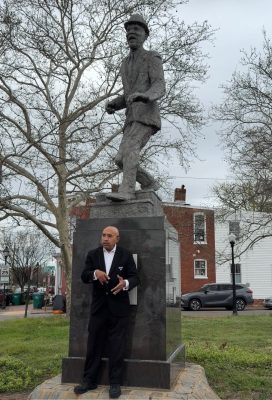
Tour guide and native Richmonder, Gary Flowers, standing in front of the Bill “Bojangles” Robinson statue.
But I think there’s something to the idea that loving a place fully means knowing it fully — the beautiful parts and the brutal parts, the pride and the shame, the stories that made it into the textbooks and the ones that didn’t. Richmond has all of that in extraordinary measure. And we are so lucky, genuinely lucky, to have institutions like the Valentine and the Black History Museum that are doing the hard work of holding all of it.
I Know Richmond runs each fall and spring through the Valentine — six Sundays, deeply worth it if you can commit. But the Black History Museum is available to you right now, Wednesday through Saturday, 10 to 5, at 122 West Leigh Street in Jackson Ward. No waitlist. No six-week commitment. Just go.
RVA has given a lot of us a lot. Knowing its full story feels like the least we can do in return.